
The Middle Squeeze
Naming the organizing story of America’s authoritarian nationalist movement
If there is a throughline to the story being told by the authoritarian movement we confront today, it is that “real Americans” are under siege, betrayed by elites from above and swamped by outsiders from below. Squeezed in the middle, real Americans are having their country stolen out from under them. We can call this conspiratorial worldview the middle squeeze, and it’s the core animating lie for the modern authoritarian movement reshaping American politics. If we are to turn back the active threat to American democracy, we must be able to grapple with the narrative they organize their movement around.
The Middle Squeeze
The middle squeeze is the idea that the deserving middle is being crushed from both above (elites) and below (outsiders, immigrants, welfare recipients, activists). It’s a conspiratorial narrative that transforms economic and social insecurity into a story of national betrayal — and offers authoritarianism as the cure. The middle squeeze interprets the world through a lens that sees a cabal of un-American “globalist” elites stealing from the deserving real Americans who make up the vast middle to give handouts to marginalized un-Americans at the bottom in trade for keeping those elites in power, squeezing the middle from above and below.
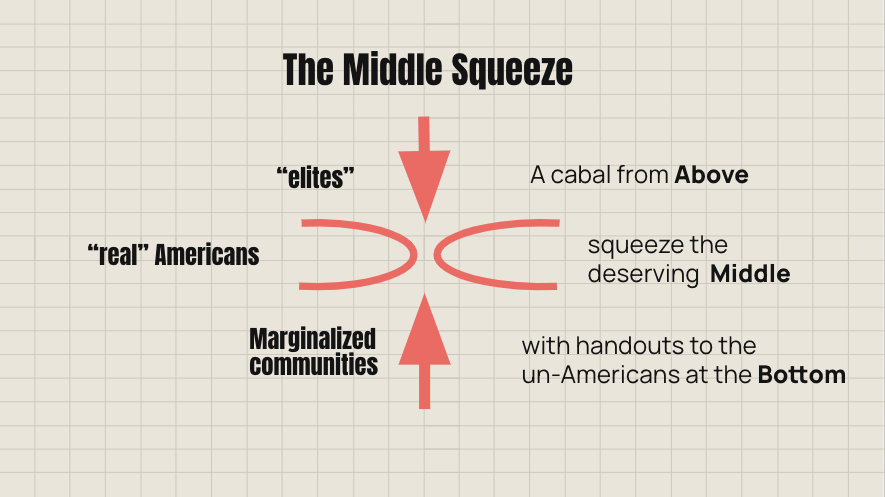
It’s important to note here that “elites” for the middle squeezers can be as much an aesthetic or cultural determination as it is one of a position of power and privilege. In the middle squeeze analysis, for example, an adjunct professor teaching a course on feminism at a middling community college could be an “elite” helping to squeeze the real Americans out of their country.
An Organizing Story
The relevance here for us is that the middle squeeze is the leading American right’s organizing story. An organizing story is a shared answer to the questions: what is broken, who broke it, and how to fix it. Successful movements of any stripe will have an organizing story that they can mobilize to take collective action around.
The mainstream version of the middle squeeze we hear today is:
What is broken: Real Americans, who make up the vast middle, are having their country stolen out from under them, struggling to get by with no one looking out for their interests or responding to their concerns.
Who broke it: A cabal of globalist elites with un-Americans already here and un-Americans the globalists imported to replace real Americans.
How to fix it: Massive purges of the un-Americans and lockdown democracy so it cannot pollute the will of the real Americans.
An organizing story is a worldview, the shared mechanism for interpreting events that binds individuals together despite the significant complexity and disagreement across the movement. Whether or not any individual, leader, or activist believes the middle squeeze narrative in their heart of hearts is irrelevant. It can be out of convenience or conviction, but what matters is their support or participation in the movement. It’s the external determination that can help group together a complicated phenomenon of those who compete with one another more often than they collaborate into an identifiable movement.
There is a vast complexity, nuance, and contradiction across the modern American authoritarian movement and its ideas, organizations, and strategies. The point here is to use the middle squeeze to name the forest despite the vast variation of the individual trees. To identify a shared story across the movement and across the history of its development. A version of the middle squeeze has organized the modern American authoritarian movement for the last half-century.
Authoritarian Conclusions
When we examine this organizing story of the middle squeeze a bit closer, we can see that it results in two important authoritarian conclusions.
Conclusion one: The government needs to be granted extraordinary powers to be able to track down and purge the un-Americans in elite positions and masses at the bottom to protect the real American people in the middle. The authoritarian concentration of power here is critical to attack the elites who otherwise would set the rules to protect themselves.
Conclusion 2: Democracy is too vulnerable of a system to be trusted. The un-Americans pollute the system, delivering the wrong results. Major crackdowns on democratic processes, like voting and protest, are necessary because demonstrations of mass collective action are just further manipulations of un-Americans against the authoritarians to justify the continuation of un-American elite power.
The conclusions drive the movement direction towards the authoritarian concentration of power and profit, despite any varying detours or political rhetoric to the contrary.
New Nationalism
A new politics of nationalism often provides the substance for the middle squeeze. While not the sole villain, a major animating force in propelling the authoritarian movement’s mainstream argument has been the globalist elites facilitating an “invasion” of immigrants to replace the real American people. This middle squeeze lie provides both the popular justification for rolling out the practical aspects of their authoritarian agenda (secret police, troops in the streets, prosecution of political opponents, etc) and context for redefining who is a real American and who is part of the invasion.
We are watching an example of this new nationalist middle squeeze play out around the shutdown as the leading voices on the American right argue that Democrats are hurting real Americans to provide handouts in the form of healthcare to our undocumented neighbors.
Nor is this focus on the middle real people alien to other authoritarian nationalist movements. Historian Eric Hobsbawm notes in his book Nations and Nationalism Since 1780, “work on the social composition of Italian and German fascism leaves no doubt that these movements drew their strength essentially from the middle strata.” Hobsbawm uncovers that this focus on the middle was a central feature from the start of the radical right’s nationalism. He writes by the late 19th century:
“Uncertainty about their status and definition, the insecurity of large strata situated between the unquestionable sons and daughters of manual toil and the unquestioned members of the upper and upper middle classes, overcompensation by claims to uniqueness and superiority threatened by someone or other - these provided links between the modest middle strata and a militant nationalism, which may almost be definable as a response to such threats - from workers, from foreign states and individuals, from immigrants, from the capitalists and financiers so readily identifiable with the Jews, who were also seen as the revolutionary agitators. For these middle strata saw themselves as embattled and endangered. . . nationalism thus mutated from a concept associated with liberalism in the left, to a chauvinist, imperialist and xenophobic movement of the right, or more precisely, the radical right.”
This new nationalism (neonationalism) is a critical component of the modern American authoritarian movement’s middle squeeze story and will be explored more as I unpack this movement throughout the course of this blog.
Origins
Similarly, I want to make cursory acknowledgment of the origins of the middle squeeze here before elaborating further in future blog posts.
Likewise, the naming of the movement we are up against as “new” or “modern” helps to highlight the dual origins of the middle squeeze argument and its accompanying movement. We can locate much of the early formations of the ideas of a nationalist threat of un-American forces from above and below, a century ago, in the twin movements of eugenics and the second wave of the Klan. With the origins of the modern movement building on the margins in the mid-1960s, in what they perceived as a bureaucratic revolution in the form of the Civil Rights and Immigration and Nationality Acts.
More specifically, the middle squeeze was first identified in the critically important analysis of George Wallace voters by sociologist Don Warren. In his book, The Radical Center, Warren describes this bloc the American electorate as “Middle American Radicals” (MAR). Writing:
“The MAR consistently sees an unholy alliance growing between the liberal and minority establishment at his expense. White efforts to end racism have forced him to carry out good deeds, through his taxes, that he never felt compelled to institute. The burden falls on his shoulders to carry out the “social experiment” rather than the affluent suburbanite or on the welfare poor. The Middle American Radical sees the government–local to national-allied simultaneously with minority and idealistic doctrines against his own interests and social survival.”
Warren’s analysis would be picked up by Pat Buchanan’s close confidant, Sam Francis. In so doing, Francis describes MARs in a sharper orientation towards a neonationalist politics, writing that they “see themselves as an exploited and dispossessed group, excluded from meaningful political participation, threatened by tax and trade policies of the government, victimized by its tolerance of crime, immigration, and social deviance, and ignored or ridiculed by the major cultural institutions of the media and education.”
A marginal and frustrated crank at the time of his death in 2005, Francis’s analysis nonetheless outlines the middle squeeze narrative that is animating an authoritarian movement that has captured the power of the White House. And we would do well to start to better understand the story the enemies of American democracy tell.